
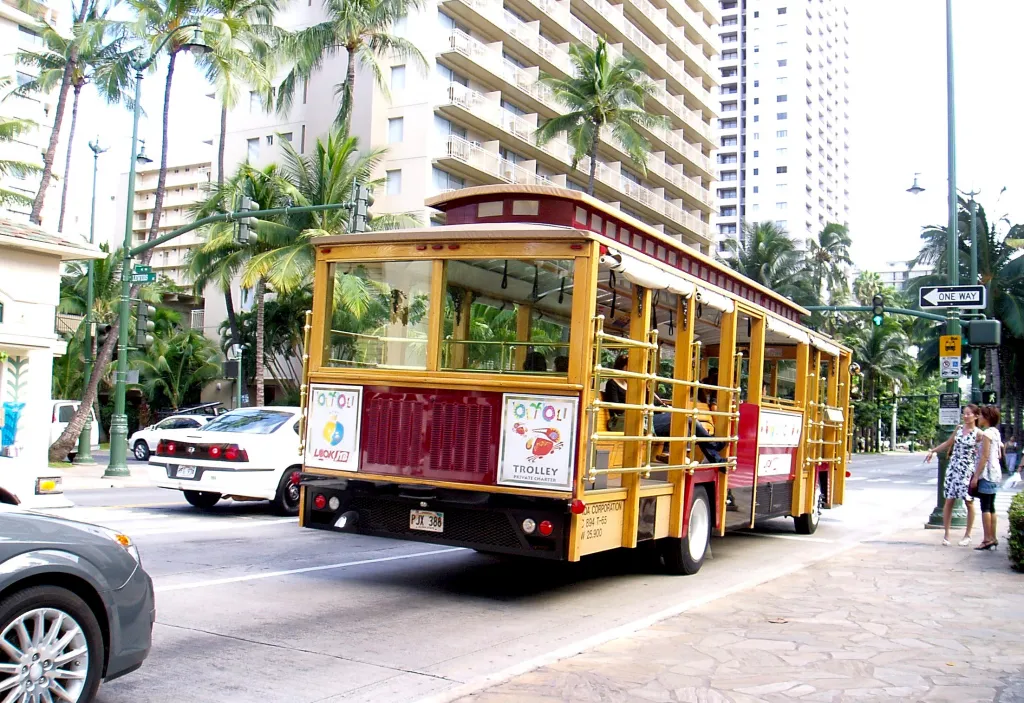
If your stomach files a complaint the second the trolley turns, Waikiki can feel like a roller coaster in flip flops. Board early and claim a forward facing seat near the front third or right over the axles where the bounce softens. Plant your feet and fix your eyes on Diamond Head while trade winds rattle the open sides and beach music drifts in. Still unsure which line gets the most curves and which seats to skip?
Key Takeaways
- Sit mid-car, centered over or just ahead of the axles, to minimize bounce, pitch, and side-to-side sway.
- Choose forward-facing seats in the middle third of a bench, about 3–4 seats from either end, for best stability.
- Avoid the very front and last two rows, where steering/braking jolts and rear sway amplify motion on curves.
- Skip outward-facing edge seats and doorway/step-up areas; crosswinds and boarding foot traffic increase lateral movement.
- When queasy, face forward and fix your gaze on the ocean horizon or a distant landmark while breathing slowly.

Oahu Grand Circle Island Experience from Waikiki
Enjoy Grand Circle Island experience tour with breathtaking views of Amelia Earhart Lookout on Diamond Head, admire Chinaman’s Hat in front of Kualo...

Waikiki Turtle Snorkeling & 6-in-1 Adventure with Free Pickup
Experience a special turtle snorkeling adventure in Waikiki aboard a smooth and comfortable catamaran. This all-in-o...

Oahu Circle Island Snorkeling Tour: Dole, Pali Lookout & More
Looking for the BEST VALUE & MOST COMPLETE Circle Island Snorkeling Tour? Join us for the ultimate full-day, action-...

Waikiki Glass Bottom Boat Cruise
Experience the beauty of Oʻahu South Shore as we sail toward Lēʻahi (Diamond Head) aboard the spacious Haleiwa Qu...
Waikiki Trolley Motion Sickness: Fastest Relief
Often, the quickest way to beat motion sickness on the Waikiki Trolley starts before you even sit down. Show up 10 to 15 minutes early at the Duke Kahanamoku Statue or Plaza stop for the first pickup, so you can grab a forward-facing spot near the front and watch the road roll by. On the Blue Line toward Halona Blowhole, keep your gaze on the ocean horizon. Skip your phone. The open-air breeze and steady view work like a simple reset button. If you’re also hoping to take photos while staying comfortable, aim for seats recommended as the best spots on the Waikiki Trolley for clear, unobstructed shots so you can keep your head steady and your eyes on the view.
If your stomach still does a little hula, get more air. Ride Outside on an open bench or crack a window. Sip a little water or chew ginger. Avoid greasy snacks until later. For the fastest fix, hop off at the next stop, plant your feet shoulder-width, face forward, and take slow deep breaths while you lock onto a distant point. Then climb back on, steady.
Best Seat on the Waikiki Trolley (Quick Pick)
Grab a mid-bench, forward-facing seat near the center over the axle, and you’ll feel fewer jolts as the trolley hums through Blue Line curves. Pick the open-air left side for ocean views and a steady horizon, and if you can, snag a wind-sheltered or shaded spot to cut glare and keep your stomach calm. Show up 10 to 15 minutes early at busy stops like the Duke Kahanamoku Statue so you can claim that sweet mid-car perch before everyone else does. Pair your seat choice with sun‑smart outfits that balance breeze, coverage, and comfort so you stay cool and focused on the horizon instead of your stomach.
Mid-Bench, Forward-Facing
If you want the quickest win against motion sensitivity on the Waikīkī Trolley, aim for a mid-bench, forward-facing seat about halfway down the open-air car. You’ll feel fewer nods on rough patches and you still get that view ahead. Pick the middle third of the bench, about 3 to 4 seats from either end, and let the breeze and hum fade into background. For less glare and heat, pair this seat choice with sun-safe seating that keeps you out of direct midday rays. Keep your eyes on the horizon and lock onto Diamond Head or the lane line when curves show up. Arrive 10 to 15 minutes early at stops like the Duke Kahanamoku Statue so you’re not stuck standing.
| Do this | What you notice | Why it helps |
|---|---|---|
| Sit mid-row | Steadier ride | Less sway |
| Look ahead | Clear road view | Calms balance |
Center Seats Over Axles
For the quickest, calmest seat on the Waikīkī Trolley, slide into the center spots right over the axles. You’ll feel less bounce when the driver rolls over seams in the road, and less side-to-side sway in turns. Those center seats sit where the trolley pitches and rolls the least, so your stomach can relax and you can listen to the clack of the wheels. If you use a wheelchair, confirm which stops have wheelchair accessible boarding so you can plan ahead and reduce last-minute rushing or extra motion.
On open-air benches, perch slightly forward above the wheel wells where the suspension does its best work. If you can’t see axle markers, aim for the first or second bench behind the driver for a solid mid-vehicle pick. Show up 10 to 15 minutes early at busy stops and queue for these spots. Face forward with a clear view ahead.
Wind-Sheltered Side Seats
Watching the palm tops lean and hearing the ocean hiss along Kalākaua Avenue, you’ll feel a lot better on a wind-sheltered side seats. On the Waikiki Trolley, pick the leeward side by checking flags or hair. You’ll dodge spray and the sharp breeze that can kick up queasiness. Use the official Waikiki Trolley Stops Map to spot stops with easier access and shorter waits so you can choose calmer boarding points that match your motion needs. Sit near the midpoint on the sheltered inner bench toward the curb. It sways less than the ends on the Blue Line’s two-hour coastal loop. On gusty days, choose a covered car and aim just behind the driver for calmer sightlines. You’ll still catch surf glittering nearby. Show up 10 to 15 minutes early at the Duke Kahanamoku Statue stop.
| Pick | Feel | Benefit |
|---|---|---|
| Leeward | Calm | Dryer |
| Midcar | Steady | Easier |
| Curbside | Shielded | Gentler |
| Behind cab | Blocked | Smoother |
Still comparing Diamond Head?
Ask for tour ideas, hotel suggestions, or a simple trip plan that combines both.
Trip Helper
Seats to Avoid on the Waikiki Trolley
Start by skipping the rear bench over the axle because every bump lands hard through the wooden seat and the trolley sways like it’s testing your sea legs. Next, avoid open-side edge seats where wind whips in and the ocean view can pull your eyes sideways while your body keeps rolling forward. Finally, pass on doorway and step-up seats since people hop on and off and their shifting weight sends little jolts through the floor when you least expect it. If you’re also managing limited mobility, pairing these seat choices with the best routes that minimize walking can make your Waikiki Trolley ride much more comfortable.
Rear Bench Over Axle
Gravity has a favorite seat on the Waikīkī trolley, and it’s the rear bench parked over the axle. When you hit a pothole, that spot pops up and sways. On Kalākaua Avenue turns, the roll can feel twice as big, like you’re balancing shave ice on your knees.
- The floor thumps under your sandals
- Your hips bounce with each seam in the pavement
- The rattan seatback chatters like a maraca
- Streetlights blur in your side vision on coastal curves
For riders using wheelchair ramps, boarding earlier also gives drivers more time to secure mobility devices before the trolley hits those bumpier sections. If you’re motion sensitive, skip the last two rows and board early at Duke Kahanamoku Statue or Waikīkī Shopping Plaza. If you must sit back, pick an inner-facing seat near the aisle. Better yet, grab mid-car seats one or two rows forward for smoother rolling.
Open-Side Edge Seats
Along the open side of the trolley, the edge benches can feel like the “fun seat” until Kalākaua Avenue bends and the wind grabs your shoulders. If you’re motion-sensitive, skip the open-side edge bench seats on the left ocean side. Crosswinds slap in and each turn adds side sway. Motion feels strongest near the rear axle, where the trolley swings wider. On the Blue Line coastal curves, avoid the very front and very back benches, especially near Halona Blowhole and Koko Head. Pick a spot over or just ahead of the front axle, or sit closer to the center aisle by a partial side panel. If you must ride the edge, face forward, plant your feet, and watch a far steady fixed point onshore. For a smoother experience overall, compare how your body feels on different Waikiki Trolley lines and stick with the route and seat area that feels most stable to you.
Doorway And Step-Up Seats
Even if you love being near the action, the seats by the trolley doorway and step can turn a smooth Waikīkī loop into a little stop-and-go rodeo. Each boarding brings a brake squeal, a quick lurch, and elbows brushing past your knees. Skip the first two bench rows behind the entry step, where steering inputs and foot traffic make the ride feel choppy. For more predictability, check the Waikiki Trolley timing so you’re not rushing for whatever seat is left near the door.
- Flip-flops thump on the step beside you
- A backpack sways into your shoulder
- The wheel well step-up seats wiggle with every curve
- Street bumps buzz up through the raised floor
For steadier views, aim for the middle of the trolley on the low floor. Arrive 10 to 15 minutes early and ask the driver for a center-row spot and breathe easier.
Front vs Back: Where the Ride Feels Smoother
Often, the smoothest seat on the Waikiki Trolley isn’t the one with the best bragging rights. If you sit near the trolley’s midpoint, right over the axles, you’ll feel the suspension settle down. On rough Blue Line patches it can feel 30 to 40 percent smoother than the open-air rear seating, where sway and wind turn every bump into a drumbeat. To better anticipate how your body will handle the ride, you can also use typical stop-to-stop travel times to estimate how long you’ll be on board between chances to step off and reset. The very back bench is the classic mistake. Riders often notice the spins and stomach flips within 15 to 30 minutes. The front looks tempting for that postcard view, but it also passes along steering jolts and braking thumps. Choose it only if a strong forward view keeps you calm and you can lock onto the horizon. For seasick-style motion, face forward on the driver’s side near the middle, then enjoy steady coastline sights without the rear wobble. Bring a light jacket, since wind can sneak up.
Forward-Facing vs Side Benches: What to Choose
Why does one bench feel like a gentle glide while another can turn the same Waikiki Trolley ride into a side-to-side shuffle? It comes down to where your eyes point and how the car swings. If you’re motion sensitive, choose forward-facing seats in the first two rows so you can watch the road and anticipate turns. Skip open-air side benches that face outward, especially on curvier coastal stretches, because the sideways view can confuse your inner ear. With good trolley timing, you can plan your stops so you step on just as a car arrives, keeping waits short and minimizing extra standing or jostling before you even sit down.
- You hear the engine hum steady as you look straight ahead.
- You see the next bend coming instead of getting surprised.
- You feel less wobble when you sit near the midpoint over the axle.
- You taste ginger chews on long loops and laugh at your own preparedness.
On the return, try swapping between front-forward and center-axle spots. You’ll still feel motion, but you’ll ride it, not fight it all the way.
Aisle vs Window: Balance, Breeze, and Exits
Once you’ve picked your direction and row, the next choice is more personal: aisle or window. If sway bugs you, slide to the curb-side bench away from the aisle and aim for a seat over the axles near the middle. The trolley leans through Waikiki turns and that spot feels planted, like your coffee won’t slosh. Window-side also lets you catch a clean forward view in the front third. You’ll watch the street glide by and let the horizon steady you while palms flicker and the engine hums. Pick the windward side for a cool trade-wind rinse, but stash a thin layer because gusts can sneak in near the coast. If you’re bringing a daypack or small tote, keep it tucked by your feet or on your lap so it won’t shift with the trolley’s motion, mirroring the same carry-on confidence you’d use to keep bags secure on any Waikiki ride. If you worry about exits, go aisle-adjacent near the doors. You’ll step off smoothly without twisting or sprinting, and you can keep both feet flat and slightly forward for extra calm. Bonus: less jostling when others shuffle past.
High vs Low Seats: Why Horizon View Matters
How do you make a bouncy Waikiki trolley ride feel calmer without missing the view? Skip the open-air high rear benches. They ride like a kite in the wind and you’ll feel every lean. Pick a low bench near the middle where the trolley rolls less, then slide into a center-forward seat for the smoothest rhythm. On the Waikiki Trolley Blue Line, that mid-car spot helps during the two-hour run past Halona and Koko Marina, letting you enjoy both coastal views and easy access to local eats.
On the Blue Line coastal loop, that mid-car spot helps during the two-hour run past Halona and Koko Marina. You still get a forward-facing panorama and a clean horizon view, but fewer side-to-side surprises.
- The wooden bench feels solid under you
- The engine hum stays steady under the floor
- Diamond Head sits like a fixed compass ahead
- Ocean light flashes, not whips, past the rails
Show up 10 to 15 minutes early, especially on windy afternoons, and you’ll claim the calm seat before it’s gone for you today.
Where to Look So You Don’t Feel Sick
A steady anchor for your eyes can turn a bouncy Waikiki trolley ride into something you actually enjoy. When the street starts to wiggle, resist the urge to watch palm trunks flick past right beside you. Instead, face forward and lock onto a far target. Diamond Head works like a natural compass, and the horizon over the blue water stays calm even when the trolley clatters. If you’d like to fit in the most productive day possible, consider starting your Waikiki Trolley rides earlier so you can build in breaks and still see everything at an easy pace. If you can, sit near the front so your view stays open and your brain gets a clear story. Keep your eyes on one distant point through turns, then let it drift slowly as the route changes. Mid morning or late afternoon often brings open windows, salt air, and softer light. That combo feels steadier. On longer loops, hop off for 15 minutes, stretch, and reset before you roll again. You’ll hear the bell and feel breeze but your gaze stays steady.
Seat Checklist for Motion-Sensitive Riders
Often, the seat you grab on the Waikiki trolley matters as much as the route you pick. On the Waikiki Trolley, motion sickness eases when you get steadier roll and a clean view forward. Start in the first third of the car and claim a forward-facing seat so you can watch the road ahead. Mid-morning or late afternoon light helps too here. Local riders also follow simple Waikiki Trolley etiquette like boarding calmly, keeping bags out of walkways, and giving priority seats to kupuna (elders) and families.
- Near the front bench, you hear the guide and feel less bounce in the floorboards.
- Over or just ahead of the wheel wells, the sway softens like a gentle boat rock.
- In shade with a clear sightline, glare drops and the breeze feels cooler on your face.
- With a firm backrest, feet flat, you sit planted, not perched like a flamingo.
Keep your eyes on far landmarks like Diamond Head. Tuck a cool cloth at your neck. Keep ginger chews or meds handy and you’re set.
Which Waikiki Trolley Lines Feel Most “Curvy”?
If you get motion-sensitive, you’ll notice the Blue Line feels the most “curvy” as it hugs the coast with constant bends near Halona Cove and the Koko Head shoreline. The Green Line up to Diamond Head adds a different kind of twist with steep approach roads and tighter turn sections near the trailhead. For a milder but still turn-heavy ride, the Red Line weaves through downtown with quick block-to-block corners and that start-stop city rhythm. If you want to turn those curves into a full sightseeing day, you can loosely follow the Scenic Southeast Oahu route along the Blue Line to plan stops and breaks between winding sections.
Blue Line Coastal Bends
Riding the Blue Line feels like tracing Oahu’s shoreline with a steady string of bends and dips under your seat. On the two hour loop, the curviest run hits between Waikiki and Koko Marina, where short downhills and quick climbs add wind sway to the open air benches. You’ll notice it most as the road hugs Halona Cove and swings past Sea Life Park, sometimes slowing so everyone can peek at surf. Along this stretch, you’ll also pass several of the top scenic stops highlighted on the Waikiki Trolley Blue Line route, giving you wide-open views of the coast between curves.
- Salt spray flashes through the rail slats
- Tires hum then hush on a tight curve
- Your view tilts toward cliffs then ocean
- Cameras click as the trolley leans
If motion gets to you, hop off at Koko Marina or Sea Life Park, reset, then reboard in about 40 minutes. Sit forward, mid-bench.
Green Line Diamond Head Turns
After those long Blue Line shoreline sweeps, the Green Line to Diamond Head changes the rhythm fast. You climb out of Waikīkī and the road tightens into switchbacks, so you’ll feel quick side-to-side nudges instead of one long sway. It’s curvier than the straight Pink shopping hop, and the steep grade adds a little stomach lift. For a gentler-feeling ride on this Perfect Diamond Head Morning route, aim for earlier departures when traffic is lighter and the driver can keep a smoother pace. If you’re motion-sensitive, claim a forward-facing seat near the center over the axles. Pick shade up front so you can watch a fixed horizon while palms and lava rock slide past. The peak wiggles hit during the Diamond Head ascent and descent, about 20 to 30 minutes. Pop a ginger chew, listen to the engine hum, and let the turns become part of the view for extra calm.
Red Line Downtown Curves
Often, the Red Line is where you’ll notice the Waikīkī Trolley’s “curvy” side the most, especially once it threads into Downtown Honolulu. Near ʻIolani Palace and Chinatown, narrow streets stack tight turns, sometimes every 100 to 200 feet, so you feel slow cornering more than on the open-road Pink Line. The Historic Honolulu Highlights route through this area packs many of these turns into a relatively short distance, which can amplify the feeling of curves for motion-sensitive riders.
- Tires whisper over brick-like patches at crosswalks
- Bells and brakes pulse in stop-and-go traffic
- Storefronts swing past your window like a slideshow
- The windshield frames a horizon to hold onto
If you’re motion-sensitive, grab a forward-facing seat over the front axle and keep your eyes up. Skip rear-facing benches that magnify sway. Downtown congestion can stretch segments to 30 to 50 minutes, and detours add extra bends, so check notices and aim for mid-morning.
When to Board for Better Seats (Less Waiting)
Usually, the smoothest start comes when you board on the first or second Blue Line pickup around 8:30 to 9:00 a.m., when the benches are still open and the air feels cool on your face. On the Waikiki Trolley, that lap gets you a front bench seat before the line forms at Duke Kahanamoku Statue or the Podium. Show up 10 to 15 minutes early, listen for the bell, and you’ll step aboard instead of hovering in standing room. From these early pickups, you’ll also be well positioned for an easier transfer or visit at the Ala Moana Center later in your route.
| Best time | Where to line up | Seat goal |
|---|---|---|
| 8:20 a.m. | Duke statue | Forward bench, windward side |
| 8:40 a.m. | Podium stop | Middle bench near axle |
| Later loop | Any short stop | Board before the crowd |
If you miss the front, slide to the middle by the axle. You’ll feel less pitch and roll and keep a horizon view.
What to Bring for Waikiki Trolley Nausea
Lock in that front or middle seat, then set yourself up with a small nausea kit so the ride stays fun even when the trolley sways around Ala Moana. For the Waikiki Trolley, prep starts before you step up. Take ginger chews or motion-sickness tablets 30 to 60 minutes early so your stomach stays calm while Diamond Head slides by. Pack light and practical, and keep it within easy reach.
Grab a front or middle seat and a small nausea kit, take ginger 30–60 minutes early and pack light.
- Ginger chews or dimenhydrinate tablets, tucked in a side pocket
- A refillable bottle so you can bring water between stops
- Plain crackers or a banana, soft and simple
- A zip-top bag, plus a cooling towel or facial mist
A tiny note card with your stop name helps you relax. Skip greasy plate lunches and strong-smelling snacks beforehand. Choose the inner aisle side of a forward-facing bench, sit up straight, and let the open-air breeze do its quiet work.
If Nausea Hits Mid-Ride: What to Do
If your stomach starts doing the hula halfway through the loop, act fast and you’ll usually settle it before the next big view of Diamond Head rolls into frame. Slide to front-facing seats near the driver or the middle of the Waikiki Trolley where the ride feels smoother and the sway fades. Lock your eyes on the horizon or a far landmark like the coastline and skip reading or staring at your phone. At the first hint of motion-sickness, take dimenhydrinate 50–100 mg or meclizine 25–50 mg, or pop a ginger chew and give it 20–30 minutes. Press acupressure wrist bands on the P6 point and breathe with the salty air. If you’re still green, ask the driver for the next safe hop-off at Kapi‘olani Park or the Duke Kahanamoku Statue. Walk five minutes, sip water, then reboard when the street noise and ocean sparkle feel steady again.
Frequently Asked Questions
Is the Waikiki Trolley Wheelchair-Accessible for Riders With Balance Issues?
Yes, you’ll find Waikiki Trolley offers wheelchair accommodation and can help riders with balance issues. Ask for boarding assistance, arrive 10–15 minutes early, request entry-area seating, and bring stability aids or a service animal along.
Are Service Animals Allowed on the Trolley if They Help With Nausea?
Yes, you can bring your service animal for nausea, but don’t relax yet. You’ll meet documentation requirements at boarding, so carry any ID you’ve got. Show solid handler training, keep it leashed, and clear aisles always.
Can I Switch Seats Mid-Route if I Start Feeling Motion Sick?
Yes, you can switch seats mid-route when it’s not full. Ask the driver at a stop before aisle swapping, then pick window seating near the front row or benches, and hop off at next stop.
Do Open-Air Cars Feel Worse Than Enclosed Cars for Motion Sensitivity?
Yes, open air cars usually feel worse for you: wind effects and shifting scenery heighten your perception of motion, and the visual flow vs vestibular mismatch can trigger nausea more than enclosed cars’ stable interior cues.
What’s the Refund Policy if Motion Sickness Forces Me to End Early?
You usually can’t get a full refund if you end early, but you can chase pro rated fares by contacting customer service within the refund timeframe. Keep receipts, pass numbers, and health notes, documentation requirements can feel a mile high.
Conclusion
Now you know the Waikiki Trolley isn’t a theme ride, even if your stomach auditions. You board early, claim a forward seat over the axles, and let Diamond Head stay your lighthouse. You skip the back row where every curve claps like a drum solo. You plant your feet on the warm floorboards, sip water, and chew ginger. If nausea barges in, you breathe, look out, and hop off at the next stop for relief.

Toa Luau at Waimea Valley, Oahu
Toa Luau invites you to immerse yourself in the beauty and excitement of Polynesia on Oahu’s historic North Shore! Book any one our 3 Luau seating o...
Waikiki Turtle Canyon Guided Snorkel: Turtle Guarantee
Choose Viator’s most-reviewed Turtle Canyon snorkel tour, with more than 4,800 traveler reviews and an experienced...

Oahu's North Shore: 8-Line Zipline Adventure
Experience the ultimate Oahu zipline adventure on this 3-hour guided tour across the island’s famous North Shore...

Oahu: The Magical Mystery Show! at Hilton Waikiki Beach Hotel
Step back in Hawaii's history to 1881 when King Kalakaua visited London. You've found the hidden gem of Oahu. This i...

Oahu: Kualoa Ranch UTV Raptor Tour
Traveling with family and friends? You can enjoy the fantastic Multi-passenger UTV Raptor experience with your entire family or as a group with the ex...

Oahu: Full or Half Day Grand Circle Island Tour
Choose from two exciting ways to experience Oahu's top attractions, scenic beauty, and local culture.Option 1: Dol...

Oahu: Grand Tour Around Island with Snorkeling
Come join on a circle island adventure led by some of Hawaii’s most knowledgeable local guides and experience brea...

Parasailing Experience in Waikiki, HI
Experience the thrill of Oahu parasailing on this unforgettable 1-hour adventure from Waikiki. Soar up to 1,000 feet...
